
For decades, IT departments were essentially mechanics. Something broke, they fixed it. Someone couldn’t print, they fixed it. The Wi-Fi went down, email stopped working, or a laptop decided it had reached the end of its patience? IT grabbed the toolbox.
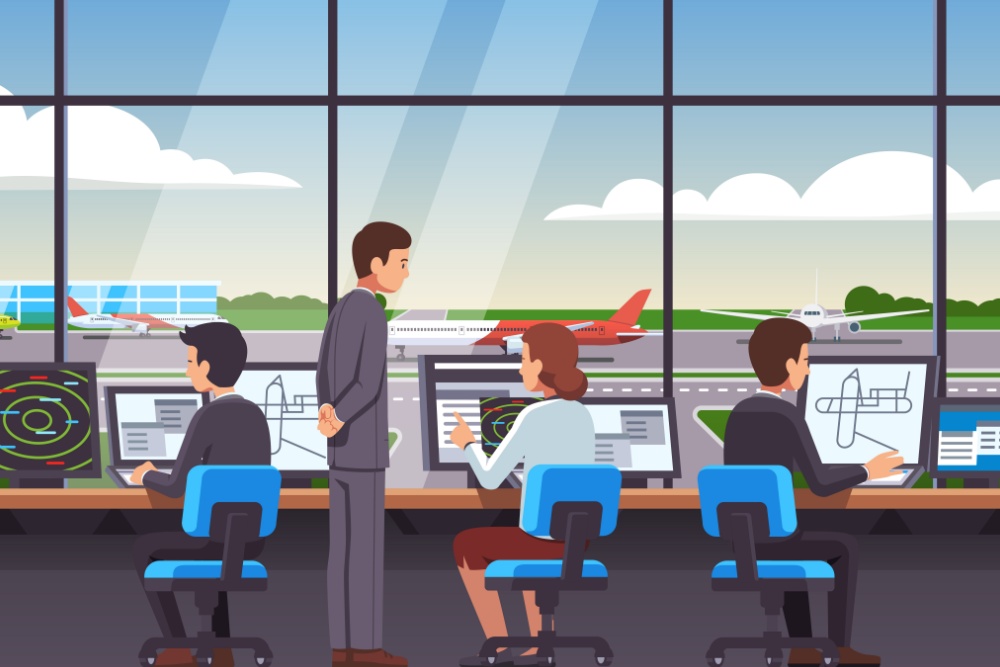
That work isn’t going away anytime soon. But it’s becoming a much smaller part of the job. Today’s IT departments are increasingly spending less time repairing technology and more time making sure an ever-growing collection of AI tools, cloud services, and automated workflows all work together. In many ways, they’re starting to look less like mechanics and a lot more like air traffic controllers.
The Airport Is Getting Crowded
Not long ago, the average organization’s technology environment was fairly simple. There were a handful of business applications, a server or two, email, maybe a CRM, and a few specialized systems. Most technology lived in one place, and the connections between systems were limited.
Today is a different story. Microsoft 365 talks to Salesforce. Copilot summarizes meetings and drafts documents. Power Automate moves information between applications. HR has its own AI assistant, marketing uses another, and finance relies on several cloud platforms that exchange data automatically. Employees are building their own workflows with low-code tools, and software vendors seem to add a new AI feature every few weeks.
Individually, all of these tools are useful. The challenge is making sure they don’t start working against one another. Increasingly, that’s becoming IT’s real responsibility.
It’s Less About Fixing… More About Coordinating
Think about what an air traffic controller actually does. They don’t build airplanes, fly them, or repair their engines. Their job is to make sure hundreds of aircraft can safely share the same airspace, arrive on time, and avoid getting in each other’s way on the runways and taxiways.
Modern IT is heading in much the same direction. Instead of simply supporting applications, IT teams are coordinating dozens—or soon hundreds—of AI agents, cloud services, and automated processes that constantly exchange information behind the scenes.
The questions they’re asking are changing, too. It used to be, “Can this application perform the task?” Increasingly, the question is, “Which system should perform the task?” Should Copilot draft the proposal? Should an AI agent create the project? Should Power Automate route the approvals? Should someone review everything before it happens? Those are coordination decisions, not technical support problems.
The Help Desk Is Changing
The support tickets of the future are likely to look very different from the ones we’ve seen for the past twenty years.
Instead of “My printer won’t print,” IT may hear questions like, “Why did the AI send this email?” or “Why did two different systems update the same customer record?” Someone else might ask why an automated workflow ran twice or why a chatbot promised something the organization doesn’t actually offer.
In many of these cases, nothing is technically broken. Every individual system worked exactly as designed. The problem is that several systems made perfectly logical decisions that didn’t add up to the outcome anyone actually wanted. That’s not a hardware failure—it’s a coordination problem.
The Biggest Risk Isn’t Technology. It’s Complexity
Most organizations aren’t going to have just one AI assistant. Before long, they’ll probably have dozens. Different departments will choose different tools, vendors will continue embedding AI into nearly every application they sell, and employees will create their own automations to make everyday work easier.
Each new tool may save time on its own. Together, however, they can create an environment that’s surprisingly difficult to manage. Without clear oversight, organizations can end up with duplicate automations, conflicting workflows, inconsistent data, and AI agents making decisions that nobody fully understands or even realizes are happening.
It’s a little like running an airport where every pilot chooses a runway without talking to the control tower. Everyone is trying to get somewhere, but eventually they’re going to start getting in each other’s way.
Governance Is Becoming Essential
For years, governance sounded like one of those topics that only interested auditors and compliance officers. AI is changing that. As organizations adopt more intelligent systems, governance becomes the framework that keeps everything running safely and predictably.
Someone has to decide which AI tools are approved, which systems are allowed to exchange information, where human approval is required, who owns each workflow, and how automated decisions are monitored. Those conversations used to happen primarily in large enterprises with massive IT departments. Today they’re becoming increasingly relevant for organizations with only a few dozen employees.
Time to Get Your Control Tower in Order!
The organizations that succeed over the next several years probably won’t be the ones with the largest collection of AI tools. They’ll be the ones that coordinate those tools most effectively.
As AI agents, cloud platforms, and automation become woven into everyday work, success won’t come from adding more technology. It will come from making sure all those technologies work together intelligently. The IT department isn’t disappearing—it is simply moving into the control tower, quietly orchestrating everything happening below. And if they do their job well, most employees will never even notice just how busy the skies have become.
For forty-three years, CGNET has provided state-of-the-art IT services to organizations of all sizes, across the globe. We’ve done it all, from IT and cybersecurity assessments to cloud services management to generative AI user training. Want to learn more about who we are and how we might be able to help you? If so, check out our website or send us a message!



0 Comments