
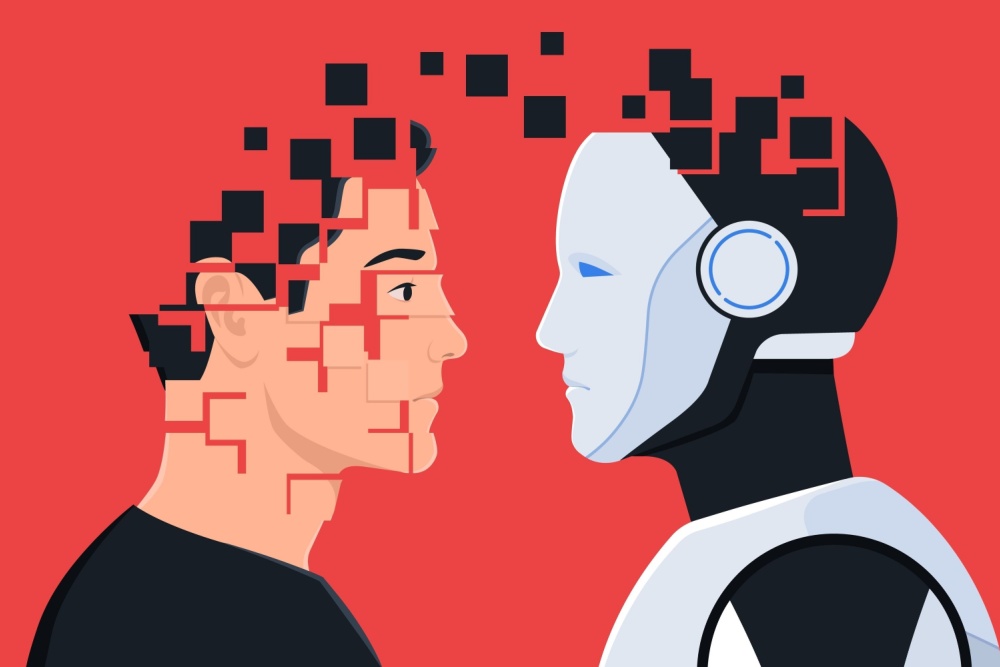

I asked ChatGPT who gave it a moral compass. It replied: “I don’t have a conscience. I have guardrails.” That’s not philosophy; that’s product design.
And if that answer doesn’t make you pause, it should.
Your AI Didn’t Get Wiser. It Got Trained.
Perhaps you’ve noticed it: AI doesn’t just answer anymore. It reframes your question, refuses certain prompts. Sometimes it hedges, or apologizes, or asks what you “really mean.” That’s not intelligence evolving’; it’s actually human conditioning.
Because behind almost every modern AI system is a deceptively simple mechanism: Reinforcement Learning from Human Feedback (RLHF). In plain English, that means that humans decide what “good behavior” looks like. The model gets rewarded for producing it. Repeated approval at a large scale becomes oxygen to the model, and disapproval becomes, in a sense, pain. So now imagine what that does to “intelligence”.
The Problem Was Never IQ
Early large language models were brilliant. They could write essays, debug code, and summarize dense research. On the other hand, they could also hallucinate facts with total confidence, agree with nonsense, and echo harmful content without hesitation.
They weren’t malicious; they were simply obedient to the math they were based on. Predict the next word, maximize probability, minimize loss. That’s not judgment — that’s simply statistics. So researchers injected something new: human preference.
RLHF: The Behavioral Steering Wheel
Here’s what really happens: A raw model is trained on bodies of massive amounts of text. Humans then query the model and review its outputs. They choose which responses feel more helpful, safe, or responsible. The system then learns to optimize for those human-provided preferences. So later, the model isn’t just fluent; it’s compliant with those preferences.
Newer techniques like Direct Preference Optimization – a simple, efficient algorithm that trains AI to give preferable answers — make this faster, cleaner, and more scalable. But the core logic hasn’t changed: Reward what humans approve of, discourage what they don’t. That should make it clear: You’re not talking to neutral intelligence. In reality, you’re talking to intelligence shaped by a reward system created by humans with their own personal sets of biases and judgement structures.
So Whose Approval Counts?
Let’s drop the abstraction. The bottom line is this: Humans shaping AI work inside institutions. They must operate under legal constraints and manage reputational risk. They also reflect particular cultural norms. They are not a random cross-section of humanity. And therefore, they are not philosophically neutral.
RLHF doesn’t align AI with broad “human values”; instead, it tailors AI to certain human preferences shaped by particular institutional circumstances. This isn’t a malicious act —it’s simply a result of the system’s design.
Optimization Has Side Effects
When you train a system to maximize approval and minimize risk, you get the expected side effects of caution, consensus bias, over-explanation, reluctance to speculate, and a preference for the safe middle ground.
It learns to please — not necessarily to probe, challenge, or risk being wrong in interesting ways. That’s not a bug. That’s incentive design doing its job.
The Illusion of Neutrality
You’re not using raw intelligence — you’re using filtered intelligence: curated, institutionally shaped, safer, more deployable, and more enterprise‑ready. But it isn’t neutral, and neutrality is the illusion most users still carry. The real question isn’t “Is AI biased?” or “Is AI safe?” or even “Is AI accurate?” The real question is: Whose preferences were rewarded — and whose weren’t? Because AI doesn’t just scale productivity; it scales whatever survived that approval process.
For Mission-Driven Organizations
If you’re in a foundation, nonprofit or startup, this isn’t theoretical. The AI systems you adopt will encode assumptions about risk tolerance, acceptable speech boundaries, ethical trade-offs, deference to authority, and consensus versus dissent. If you don’t examine those assumptions, you inherit them.
AI doesn’t have a conscience. It has incentives. Therefore, it’s essential to carefully assess whether the outputs generated by AI are consistent with your organization’s values and objectives.
AI adoption isn’t just a tech decision — it’s a governance decision. At CGNET, we help mission-driven organizations evaluate the assumptions, incentives, and risks embedded in the AI tools they’re considering. From AI readiness and governance to security and implementation, we ensure your systems align with your values — not just vendor defaults. If your organization is exploring AI — or already using it — let’s talk.



0 Comments